
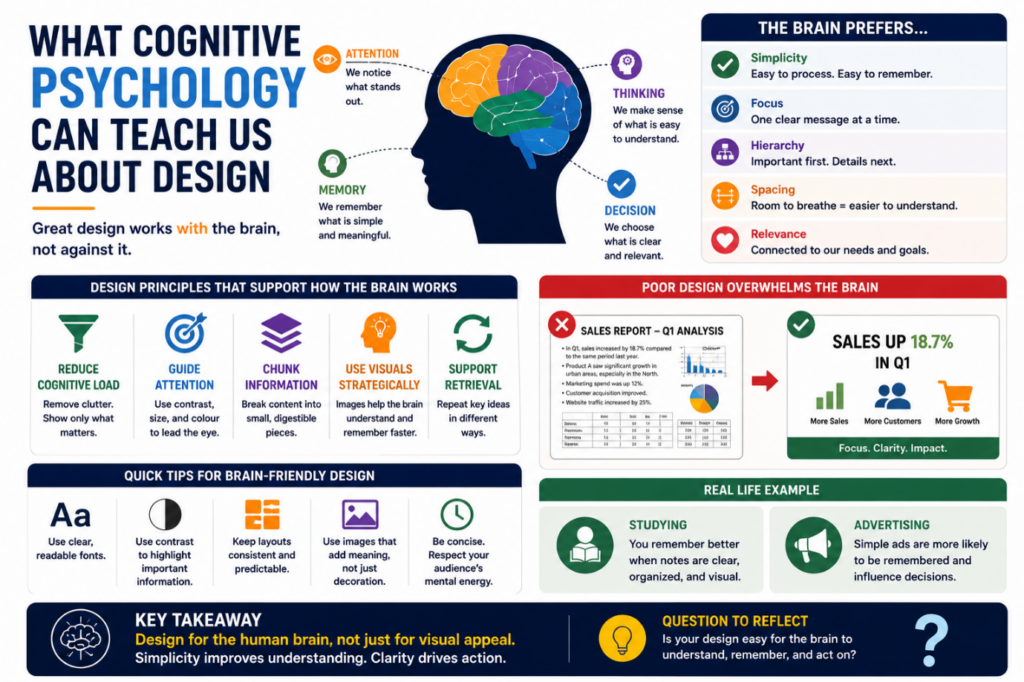
How the Human Mind Shapes What We See, Remember, and Respond To
Many people assume design is purely creative.
In reality, great design is deeply connected to how the brain works.
Cognitive psychology helps us understand:
- attention
- memory
- decision-making
- information processing
For example:
People often remember simple designs better than complex ones.
Why?
Because the brain prefers information that is easy to process.
This is why cluttered designs often fail.
Key Takeaway
Design for the human brain, not just for visual appeal.
Simplicity improves understanding.
References
Johnson, J. (2020). Designing with the Mind in Mind: Simple Guide to Understanding User Interface Design Guidelines (3rd ed.). Morgan Kaufmann.
Kahneman, D. (2011). Thinking, Fast and Slow. Farrar, Straus and Giroux.
Krug, S. (2014). Don’t Make Me Think, Revisited: A Common Sense Approach to Web Usability (3rd ed.). New Riders.
Lester, P. M. (2018). Visual Communication: Images with Messages (8th ed.). Cengage Learning.
Lidwell, W., Holden, K., & Butler, J. (2010). Universal Principles of Design (2nd ed.). Rockport Publishers.
Norman, D. A. (2013). The Design of Everyday Things (Revised and Expanded Edition). Basic Books.